The Poem Johnson PhD Papers: Tidalectics Re-imagined (after Kamau Brathwaite)

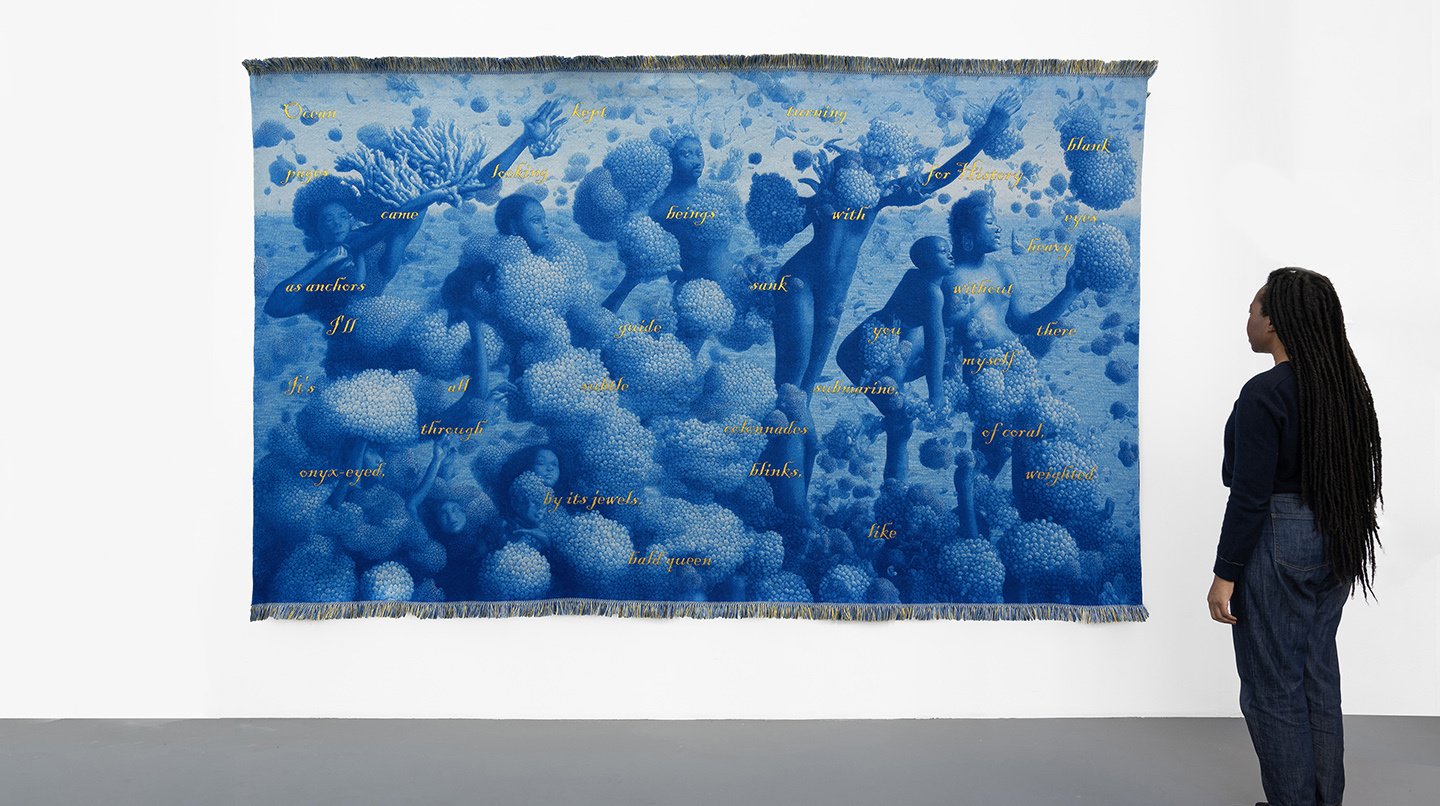 Poem Johnson, “Returns,” 200 x 350 cm (78.7 × 137.8 inches), cotton, merino wool, polyester woven together. Exhibited at Galerie Mitterrand, Paris, 2024. Photo by Axel Fried.
What is your PhD research about?
In the year 2088, the artist Poem Johnson dies at the age of 102. His estate bequeaths his artworks and papers to the Kamau Brathwaite Center for Research in Black Studies. The archive contains eleven artistic outputs spanning weavings, videos, performance works, and an artist book produced between 2021 and 2026.
This speculative framework structures my entire practice-based dissertation, positioning the work as already archived in the future. By displacing linear historiography through this future-oriented framing, the research examines how artists from diasporic communities can shape archival custody and posthumous reception of their work before institutional stewardship begins.
The speculative fabulation draws on Kamau Brathwaite's concept of tidalectics, a geopoetic model of history that combines Einsteinian non-linear time with Caribbean routes and roots. Brathwaite argues that diasporic histories cannot be traced to a single origin point. In the context of African diaspora, where displacement and forced migration fracture linear genealogies, identity and history move in tidal patterns across multiple shores and temporalities. This dissertation reimagines tidalectics through material practice, using the speculative structure to displace linear historiography, interrogate the politics of memory-making, and challenge the assumed stability and permanence of archival records.
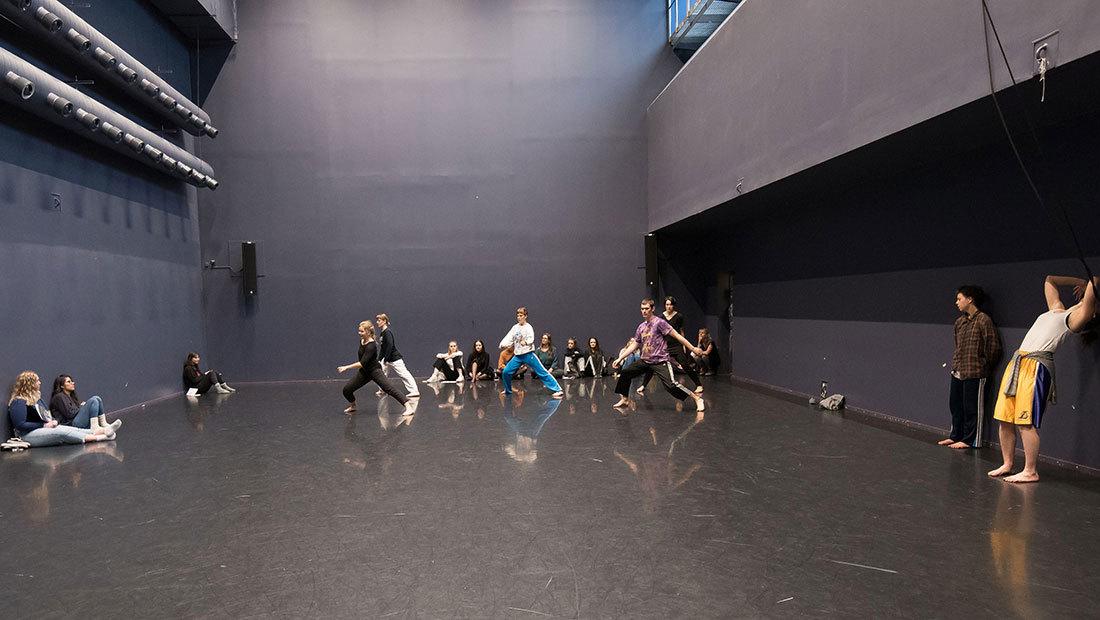
The artworks trace a research journey of artistic experiments conducted between 2021 and 2026. The Sea is History (2024) is a series of Jacquard-woven textiles that engage the colonial legacies of industrial textile production and cotton economies while rendering the ocean as living archive. The loom's punch-card system is itself an early form of data storage, and becomes a site for counter-archival practice that reclaims colonial infrastructure to materialize suppressed narratives. Sun/Sum (2024) is a performance work developed through public rehearsals that privileges process over product, establishing rehearsal-as-research methodology where Afrodiasporic movement vocabularies circulate through iterative process rather than fixed performance scores. Riot/Uprising (2023) is a three-channel video installation that foregrounds the materiality of decaying footage from the 1971 Attica prison uprising, directing attention across screens through sound remixing.
Through speculative fabulation, the dissertation generates a post-custodial future: practical frameworks for how artists from diasporic and Indigenous communities can intervene in preservation systems before depositing materials into institutional care, shaping how their work will be encountered, interpreted, and activated by future researchers and communities.
Why does this research matter?
“The Poem Johnson PhD Papers” (2021-2026) opens two previously hidden opportunities for the field of artistic research, with particular significance for historically marginalized communities including Indigenous peoples and members of the African diaspora.
The experiments conducted with the Jacquard loom materialize alternative futures for Afrodiasporic weaving practices. In the series “The Sea is History” (2024), the ocean figures as a living archive, embedding the histories of the Middle Passage. The materiality emerges from the encounter of cotton, merino wool, and polyester yarns. Plant, animal, and mineral realms are intertwined. These materials carry within them histories of natural resource extraction and environmental transformation. Through weaving, the chosen materials give form to a return of the repressed. Colonial histories of exploitation of the earth and peoples resurface, offering a reimagining of futures through mythmaking.
The research further employs speculative fabulation as method, engaging historiography as contested terrain. Members of the African diaspora have systematically been subject to archival erasure. Against this condition, the work constructs a thought experiment in which the custody of the artist's work has already been secured, already memorialized. The donation of work and archives to a community-based center for Black studies confers stability upon a narrative that might otherwise be lost. This inscription in a fictional repository operates as a practice for securing what erasure threatens, opening possibilities foreclosed by conventional historiography.
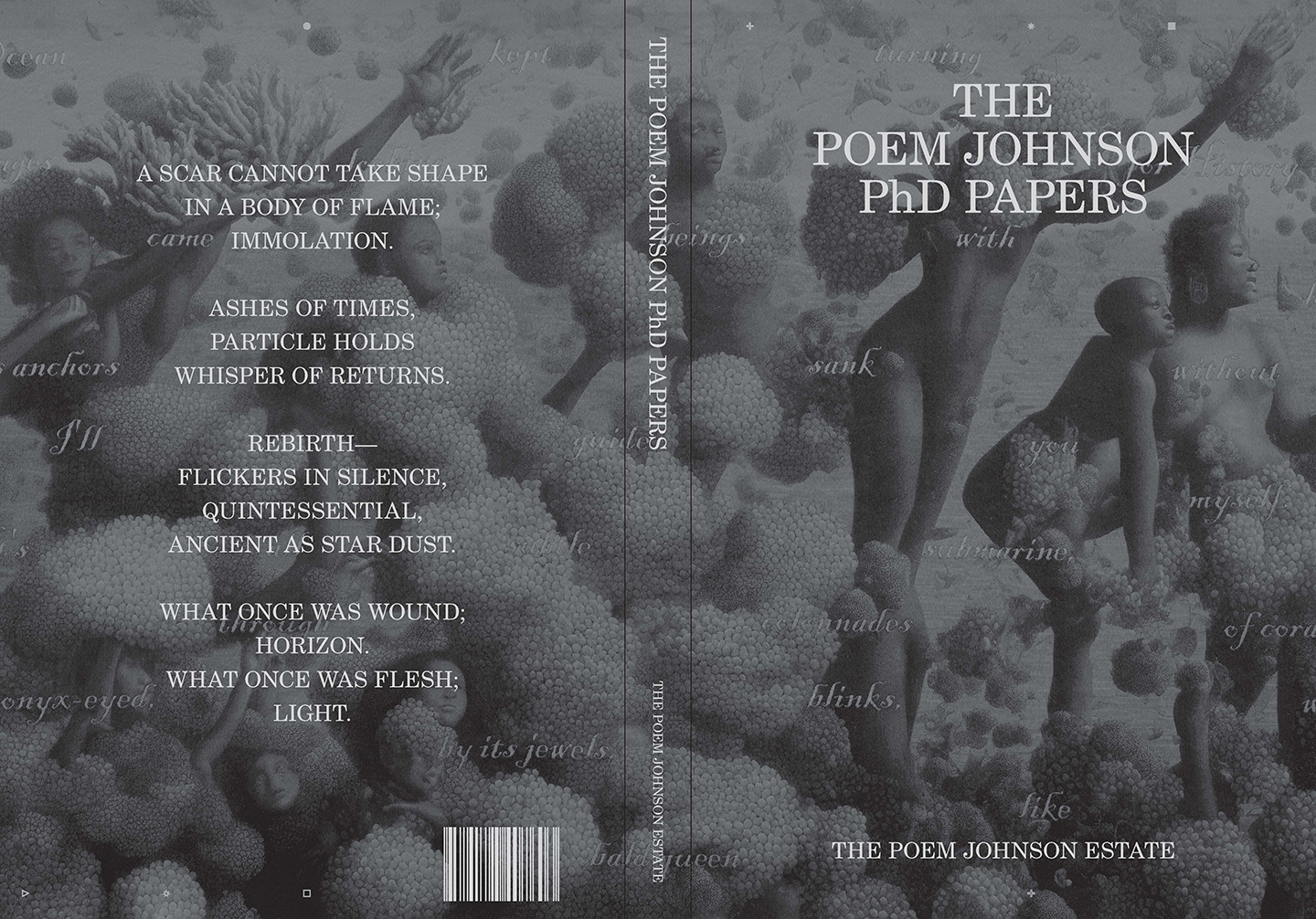 Marc Johnson, The Poem Johnson PhD Papers: Tidalectics Re-imagined (After Kamau Brathwaite) (Stockholm: Stockholm University of the Arts; Paris: The Poem Johnson Estate, 2026), X Position, no. 37. 336 pp. ISBN 978-91-88407-60-3. (Cover and back cover of the PhD thesis publication)
Acknowledgements
The research has received support from the Stockholm University of the Arts, The Buschlen Mowatt Nichol Foundation, Liljevalchs Konsthall, Joanna Sandell Wright, Galerie Mitterrand, and Olivia Anani. Marc Johnson acknowledges the support of artists, dancers, and performers Freddy Houndekindo, Ama Kyei, and Johanna Tengan for the performance Sun/Sum (2024).
Publication Credits
Graphic designer: Studio Yannick Nuss
Proofreader: Eleanor Bauer
Indexer: Jess Herdman
Printed by: UAB BALTO print, Vilnius
How does your earlier work connect to this research?
Another major research project, “Parley: How Would You Feel About Being Denied the Opportunity to Speak Your Ancestral Language?” (commissioned by the Vancouver Biennale), investigates the politics and poetics of erasure and access in relation to Indigenous cultural heritage. Over several months, I collaborated with the Museum of Anthropology at UBC, the Museum of Vancouver, and the Vancouver Maritime Museum, combining photography, video, critical museology, interviews, and writing.
The project examined how Canada's national institutions, shaped by both federal authority and Indigenous governance, negotiate the custody of cultural heritage and the conditions under which ancestral knowledge is shared, withheld, or revived. Through dialogue with First Nations artists, curators, and knowledge keepers, the artistic research encountered narratives of dispossession alongside acts of renewal, generosity, and cultural resurgence.
The resulting multi-channel video and sound installation, artist book, and photographic series made within museum reserve collections re-imagined fieldwork as an artistic methodology, foregrounding the tensions between custodianship and sovereignty.
Where the doctoral project addressed African diasporic archives through speculative futures, Parley engages Indigenous cultural materials through present-day institutional collaboration, demonstrating how questions of custody and memory manifest differently across diasporic and Indigenous contexts while requiring parallel attention to sovereignty and self-determination.
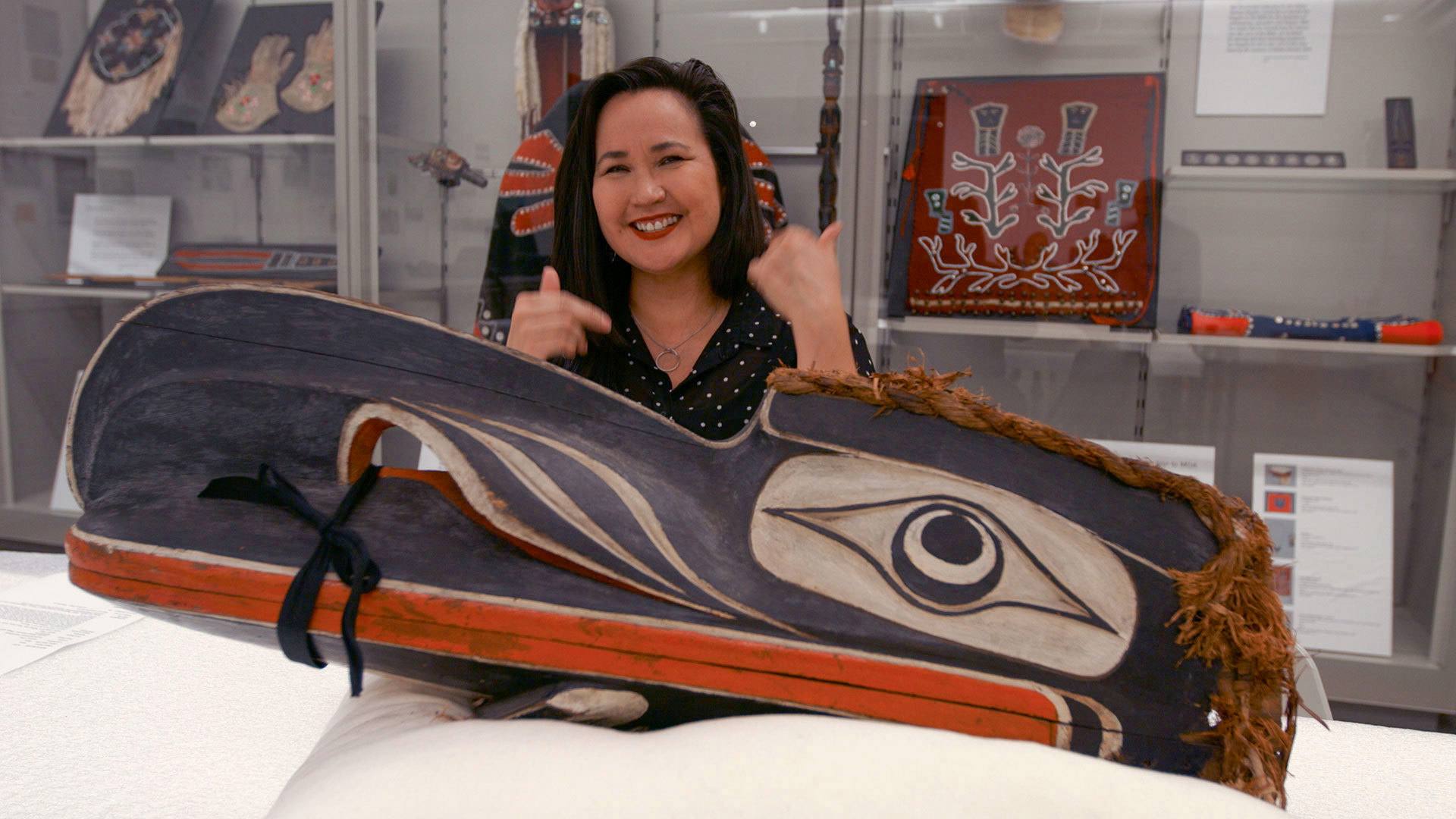
Marc Johnson, Parley (featuring Connie Watts), 2019. Multi-channel video installation. https://youtu.be/GjAtfacmaro
What shapes your artistic practice and research interests?
Working across experimental cinematography, re-montage of archival film, weaving as memorial and counter-historical practice, and speculative fabulation, my practice-based research develops what I call “vessels for counter-histories.” These works excavate suppressed histories across global diasporas and offer resonance, reflection, and revival through varied material processes.
My research investigates inter-species relationality and power relations in non-Western contexts, as well as struggles between citizens and state powers, through speculative fabulation. These approaches challenge dominant modes of historical representation that privilege chronology and institutional authority.
In the video piece YuYu (2014), I documented Chinese beekeeper Shé Zuŏ Bīn performing a traditional rite of spring, his body entirely covered by thousands of bees, witnessing forms of animistic practice against the backdrop of massive urbanization in the Yangtze Valley.
Recent textile works (2024-ongoing) combine fragments from Derek Walcott's poem “The Sea is History” with hybrid figures merging human bodies with coral, pearls, and oceanic matter. Created through collage, drawing, and digital composition before being woven in cotton, wool, and polyester on Jacquard looms, these works materialize Afro-diasporic histories of the Middle Passage and Caribbean experience. The artworks transform historical trauma into speculative, oceanic mythologies that resist archival erasure.